Q2
Q2
 QIDI Box
 Plus 4
 Q1 Pro
 X-Max 3


How Much Does 3D Printing Filament Cost


A 1 kg spool of standard 3D printing filament costs roughly $11 to $25 for PLA and PETG, $12 to $40 for ABS and ASA, $18 to $42 for TPU, and $35 to $60 for nylon. Carbon-fibre and glass-filled engineering grades run from about $25 to well over $150 per kilogram. At $20 per kilogram, a 150 g part uses $3.00 of material.
The spread between a $12 spool and a $60 spool is not marketing. It reflects the base polymer, the additives, and how tightly the diameter is controlled during extrusion. The sections below break down each factor and show how to convert a spool price into a per-part number you can budget against.
What Does 3D Printer Filament Cost per Kilogram?
Standard 1.75 mm filament sells in seven fairly stable price bands, from about $11 per kilogram for basic PLA to $150 or more for continuous-fibre and specialty engineering grades. The table below gives current market reference ranges for 1 kg spools alongside the cost of a typical 150 g part in each material.
Price note: these are general market references. Actual prices vary by region, seller, spool size, material grade, bundle discount, and promotion. Check current listings before buying.
| Material | Typical retail range, 1 kg | Cost per gram | Cost of a 150 g part | Common use cases |
| PLA / PLA+ | $11 – $25 | $0.011 – $0.025 | $1.65 – $3.75 | Everyday prints, prototypes, display models |
| PETG | $12 – $25 | $0.012 – $0.025 | $1.80 – $3.75 | General functional parts, stronger household prints |
| ABS | $12 – $30 | $0.012 – $0.030 | $1.80 – $4.50 | Heat-resistant parts, workshop use, enclosures |
| ASA | $16 – $40 | $0.016 – $0.040 | $2.40 – $6.00 | Outdoor parts, UV exposure, weather resistance |
| TPU | $18 – $42 | $0.018 – $0.042 | $2.70 – $6.30 | Flexible parts, grips, bumpers, wearables |
| Nylon / PA | $35 – $60 | $0.035 – $0.060 | $5.25 – $9.00 | Tough functional parts, wear-heavy parts |
| Reinforced and engineering blends | $25 – $150+ | $0.025 – $0.150+ | $3.75 – $22.50+ | Stiff, reinforced, high-performance applications |
Two observations matter more than the individual numbers. PLA and PETG overlap almost completely, so the choice between them should follow the part's requirements rather than price. And the jump from a commodity material to an engineering material is roughly 3x to 6x — large enough that it should follow a real requirement, not a preference.

Why Does Filament Price Vary So Much Between Materials?
Filament price tracks three things: the cost of the base polymer, the cost and difficulty of any reinforcement or additive, and how much process control the manufacturer applies during extrusion. Two spools can both be printable and still be built for entirely different environments and performance targets.
The base polymer sets the floor
PLA and PETG are made from widely produced commodity resins, print at moderate temperatures, and tolerate loose process windows, which is why they anchor the bottom of the market. ABS and ASA cost slightly more, with ASA carrying a premium for its UV-stable chemistry. Nylon sits higher because polyamide resin itself is more expensive and requires tighter drying during manufacture.
Reinforcement multiplies it
Fibre reinforcement is the single largest price multiplier in the market. A 2024 economic analysis in Polymers priced a spool of clear PETG at €60 against €300 for a continuous carbon fibre spool — a 5x difference in raw material cost. In that study, a plain PETG tensile specimen cost €0.9 to produce while the same specimen with three layers of continuous carbon fibre cost €4.1, over four times more. Chopped carbon-fibre blends sit between those extremes but follow the same logic: the fibre is expensive to make, and compounding it into a printable filament adds a process step.
Additives and specialty effects
Glow-in-the-dark, glitter, matte, silk, and wood-filled filaments carry pigment or filler costs, and abrasive fillers shorten nozzle life on top of that. See the filament types guide and the carbon fibre filament guide for what each grade is actually good for.
What Makes One PLA Spool Cost Twice as Much as Another?
Within a single material, price differences come almost entirely from diameter consistency, moisture control during packaging, and spool format. Two PLA spools with the same polymer can behave very differently on the machine.
Diameter consistency
Filament diameter tolerance is the specification that separates budget spools from premium ones, typically quoted as ±0.05 mm on low-cost filament and ±0.02 mm on tightly controlled spools. Diameter directly sets volumetric flow: a spool that swings by 0.05 mm on a 1.75 mm nominal diameter changes cross-sectional area by roughly 6%, which the extruder cannot compensate for. Research on hot-melt extrusion has shown that process fluctuations during filament production propagate directly into the critical quality attributes of the printed part, including dimensional uniformity. That is the mechanism behind under-extrusion gaps, over-extrusion bulges, and the random defects covered in the filament quality issues guide.
Moisture control at the factory
Vacuum sealing with fresh desiccant costs the manufacturer money and it is the first thing removed from a budget spool. It matters because the damage starts before you open the box. In a 2024 study of moisture-conditioned PLA, filament held at 80% relative humidity gained 0.73% of its weight in water and lost about 20% of its tensile strength, with melt flow index rising 50%. A spool that arrives already damp is not a bargain at any price.
Spool format and bulk pricing
Multi-roll bundles and refill systems change the effective price without changing the material. Refills, which ship the coil without a plastic spool, cut packaging and shipping cost for anyone who already owns reusable spools. Compare on cost per kilogram, not sticker price, and confirm net weight — some spools ship at 750 g or 800 g rather than a full kilogram.
How Do You Calculate the Filament Cost of One Print?
Divide the spool price by the spool weight in grams to get a cost per gram, then multiply by the print weight your slicer estimates. This is the number that matters for quoting, budgeting, and comparing materials on a real job.
Filament cost = (spool price ÷ spool weight in grams) × print weight in grams
A worked example: a 1 kg spool costs $20, and the slicer estimates 150 g for the part.
$20 ÷ 1000 g = $0.02 per gram, then $0.02 × 150 g = $3.00
That figure covers material only. A full job cost adds four more lines, and the table below shows how they compare on that same 150 g, 10-hour part.
| Cost component | Typical value for a 150 g, 10-hour part | How to estimate it |
| Filament | $3.00 (PLA at $20/kg) | Slicer weight × cost per gram |
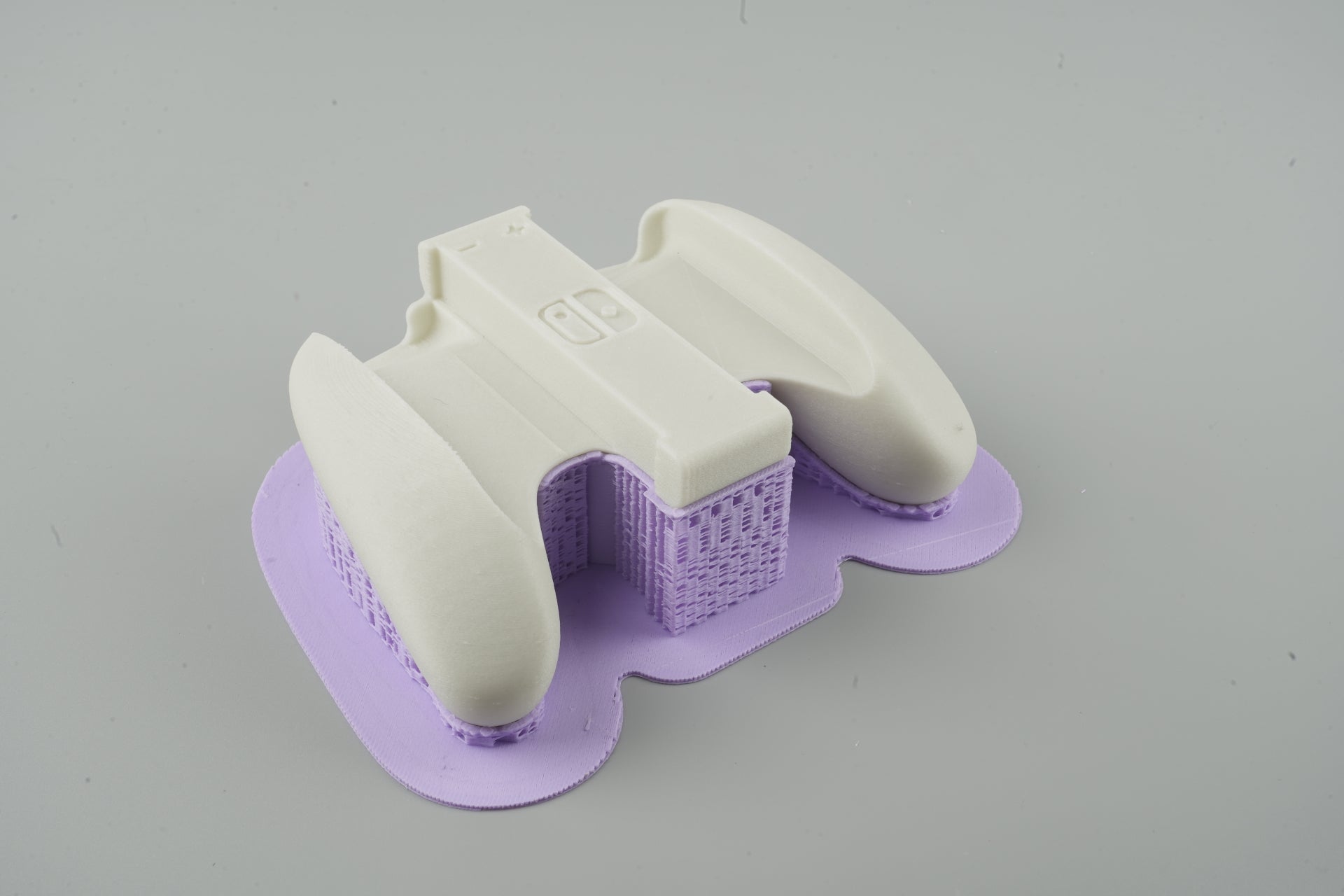
| Support and purge waste | $0.20 – $0.90 | Slicer reports it separately; multi-colour purge can exceed the part itself |
| Electricity | $0.15 – $0.83 | Average watts ÷ 1000 × hours × local price per kWh |
| Nozzle and consumable wear | $0.05 – $0.50 | Higher with abrasive fibre-filled and glow filaments |
| Failed-print allowance | $0.30 – $3.00 | Material cost × your observed failure rate |
Filament dominates every other line. Electricity, which people often assume is significant, works out to between 15 and 83 cents for that same 10-hour job depending on material and chamber use — the full arithmetic is in the 3D printer electricity cost guide. Machine wear and consumables are broken out in the maintenance cost guide. For personal use, the material line alone is usually enough for a sound buying decision.
Is It Worth Paying More for Filament?
Paying more is worth it when the cost of a failed print exceeds the price gap between the spools — which is usually true for long prints, functional parts, customer work, and hard-to-print materials, and usually false for draft models and decorative pieces.
Run the comparison directly. If a premium spool costs $10 more per kilogram and prevents one failure on a 200 g, 20-hour job, it has already paid for itself in material alone, before counting the twenty hours. If the part is a 20 g bracket that reprints in forty minutes, the same $10 buys nothing.
| Job characteristic | Buy the premium spool | Buy the budget spool |
| Print duration | Over 8 hours | Under 2 hours |
| Part role | Load-bearing or dimensionally critical | Draft, fit check, or decorative |
| Material class | Nylon, TPU, or fibre-reinforced | PLA or PETG |
| Who receives it | A paying customer | Yourself, reprintable at will |
| Cost of one failure | Exceeds the price gap per spool | Under the price gap per spool |
For load-bearing parts the answer flips almost every time. Choosing industrial 3D printing composite materials walks through when carbon-fibre and glass-filled grades earn their premium and when a standard engineering filament is already enough. Two field cases make the point concretely: filament for garden hose guides exposed to rain and UV, and filament that resists fatigue in vibrating mounts. In both, the wrong material fails regardless of what the spool cost.
How to Lower Your Filament Cost Without Lowering Print Quality
The largest savings come from fewer failed prints and better material matching, not from buying the cheapest spool. Three habits account for most of the difference.
Buy the simplest material that meets the requirement
Use PLA for prototypes, visual models, and indoor parts. Move to PETG when the part needs toughness or moisture resistance. Use ABS or ASA when heat or outdoor exposure matters. Reserve TPU, nylon, and reinforced blends for parts that genuinely need flexibility, wear resistance, or stiffness. Paying nylon prices for a desk organiser is the most common avoidable expense in this hobby. QIDI's filament collection can be filtered by material, and the PETG range is the usual step up from PLA for functional indoor parts. When a part truly needs stiffness, a chopped-fibre grade such as PET-CF is the point where the premium starts to earn out.
Compare cost per kilogram, and check net weight
A spool that looks cheaper may hold less material or lose its advantage once bundle pricing is considered. Cost per kilogram is the only clean comparison. This matters most for commodity materials bought in quantity.
Protect filament after opening
Moisture damage raises cost without adding any value, and it is entirely preventable. Sealed bins with desiccant, vacuum bags, and dry boxes all work. Materials that hold filament at a controlled temperature while printing — the QIDI Box holds its sealed chamber at 65 °C during a job — remove the risk of a long print degrading its own feedstock halfway through. If a spool has already taken on water, the filament drying guide covers recovery, and how long filament lasts covers how to keep it from getting there.
Common Mistakes When Buying Filament by Price
Choosing by price before choosing by requirement
The first question is what the part has to do. Indoors under light load, PLA is enough. Outdoors, ASA justifies its premium. If it needs to flex, no rigid spool at any price is the right purchase.
Treating PLA as universally compostable
PLA is often described as biodegradable, but the conditions matter. Research published in Polymers found that PLA-based materials need temperatures well over 50 °C to initiate biodegradation, with industrial composting at 58 °C achieving mineralisation in roughly 90 days. Ordinary household disposal does not reach those conditions, so PLA should not be treated as a material that breaks down quickly in a home bin.
Ignoring failed prints in the real cost
A spool that clogs or bonds poorly between layers is rarely a bargain. A spool that causes one failure per kilogram has effectively added its own price again.
Frequently Asked Questions
How much does PLA filament cost per kg?
A standard 1 kg PLA spool typically costs $11 to $25. Budget bundles sit near the low end; premium, tightly toleranced, and specialty PLA sits closer to $25. At $20 per kilogram, PLA works out to 2 cents per gram, or $3.00 for a 150 g part.
Is PETG more expensive than PLA?
Only slightly, and the ranges overlap almost entirely at $12 to $25 for PETG against $11 to $25 for PLA. Choose between them on the part's requirements — PETG for toughness and moisture resistance, PLA for detail and ease — rather than on a difference of a dollar or two per spool.
How much filament does a typical print use?
Most desktop prints use 20 g to 200 g. A phone stand is around 40 g, a functional bracket 60 to 120 g, and a large cosplay piece can exceed 500 g. Your slicer reports the exact figure before you print; multiply it by cost per gram for the material cost.
What is the cheapest filament for beginners?
PLA, at $11 to $25 per kilogram. It is not just the cheapest to buy but the cheapest to run, because it prints at lower temperatures, warps less, and fails less often than any other common material. The beginner filament guide covers what to look for in a first spool.
Why is carbon fibre filament so expensive?
Because the fibre itself is costly and compounding it into a printable filament adds a manufacturing step. Published cost analysis puts a continuous carbon fibre spool at five times the price of the equivalent plain PETG spool, and a reinforced test specimen at over four times the cost of an unreinforced one. Chopped-fibre grades cost less than continuous fibre but still carry a clear premium.
Does more expensive filament actually print better?
Sometimes, and the mechanism is measurable rather than mystical: tighter diameter tolerance stabilises flow, and better factory moisture control means the spool starts dry. Both reduce failure rate. On a short, simple, easily reprinted part, that reduction is not worth paying for. On a 20-hour functional print, it usually is.
How do I lower my cost per print without hurting quality?
Use the simplest material that meets the requirement, compare cost per kilogram rather than sticker price, and store filament sealed with desiccant after opening. Those three habits save more than chasing the lowest shelf price, because they attack the failure rate rather than the unit cost. Choosing a machine that prints reliably across materials also helps — the printer lineup is worth matching to the materials you actually plan to run.
- What Does 3D Printer Filament Cost per Kilogram?
- Why Does Filament Price Vary So Much Between Materials?
- The base polymer sets the floor
- Reinforcement multiplies it
- Additives and specialty effects
- What Makes One PLA Spool Cost Twice as Much as Another?
- Diameter consistency
- Moisture control at the factory
- Spool format and bulk pricing
- How Do You Calculate the Filament Cost of One Print?
- Is It Worth Paying More for Filament?
- How to Lower Your Filament Cost Without Lowering Print Quality
- Buy the simplest material that meets the requirement
- Compare cost per kilogram, and check net weight
- Protect filament after opening
- Common Mistakes When Buying Filament by Price
- Choosing by price before choosing by requirement
- Treating PLA as universally compostable
- Ignoring failed prints in the real cost
- Frequently Asked Questions
- How much does PLA filament cost per kg?
- Is PETG more expensive than PLA?
- How much filament does a typical print use?
- What is the cheapest filament for beginners?
- Why is carbon fibre filament so expensive?
- Does more expensive filament actually print better?
- How do I lower my cost per print without hurting quality?
Recommended products